

Electronic Health Records Market to Grow at 6.7% CAGR Through 2033 | Persistence Market Research
Electronic Health Records (EHR) market
Analysis of the electronic health records market, highlighting trends, drivers, challenges, regional growth, and emerging digital healthcare opportunities.
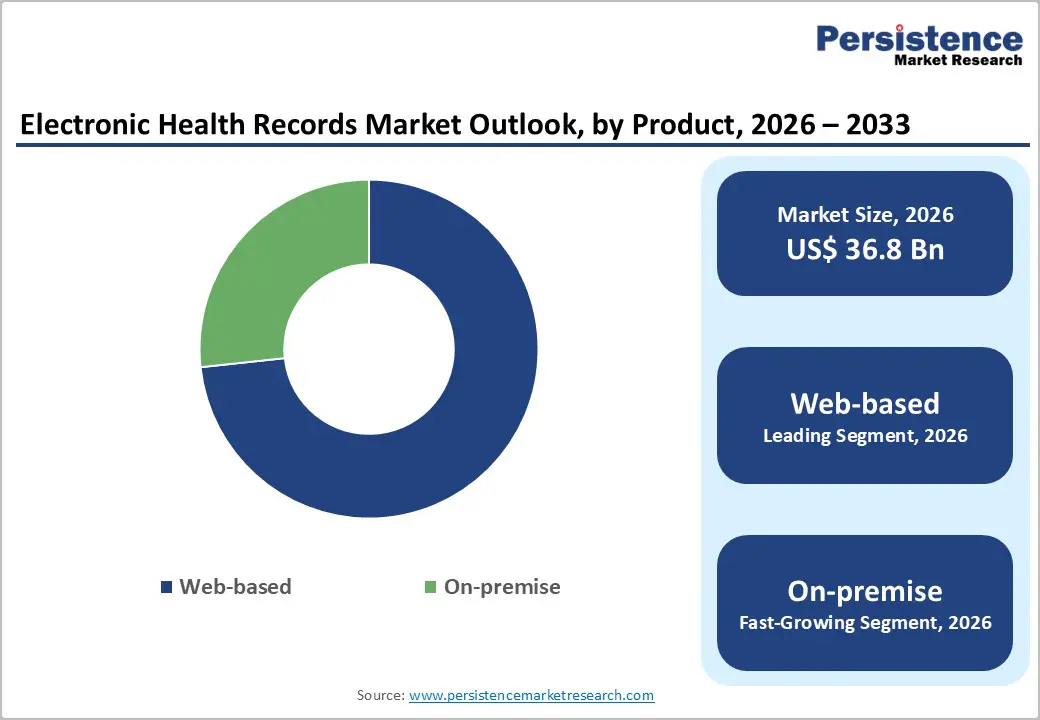
LONDON, UNITED KINGDOM, April 7, 2026 /EINPresswire.com/ -- The global Electronic Health Records (EHR) market is experiencing steady growth, driven by rapid digital transformation across the healthcare sector. The market is projected to expand from US$ 36.8 billion in 2026 to US$ 57.9 billion by 2033, registering a compound annual growth rate (CAGR) of 6.7% during the forecast period. Increasing adoption of telehealth, mobile health (mHealth), healthcare analytics, and digital care workflows is significantly contributing to this expansion. EHR systems have become essential tools for improving patient care, enhancing data accuracy, and streamlining healthcare operations.
Download Your Free Sample & Explore Key Insights: https://www.persistencemarketresearch.com/samples/34681
Key Industry Highlights
Web-based EHR solutions dominate the market, accounting for 73.3% of the total share in 2025. This dominance is attributed to the growing preference for cloud-hosted platforms that offer scalability, flexibility, and lower upfront costs. Healthcare providers, including hospitals and clinics, are increasingly adopting web-based systems to enable real-time data access, interoperability, and efficient care coordination.
Regionally, North America leads the market with a 50.7% share, supported by advanced healthcare infrastructure, high adoption rates, and favorable regulatory frameworks. Meanwhile, Asia Pacific is emerging as the fastest-growing region due to expanding healthcare infrastructure, rising patient awareness, and strong government initiatives promoting digital health adoption.
Market Drivers
One of the primary drivers of the EHR market is the increasing prevalence of chronic diseases, which necessitates efficient data management and long-term patient monitoring. EHR systems enable healthcare providers to track patient histories, reduce medical errors, and improve treatment outcomes.
Additionally, the growing adoption of telehealth and value-based care models is accelerating demand for EHR solutions. These systems support data-driven decision-making and personalized treatment plans. Government initiatives and incentive programs encouraging the transition from paper-based records to digital systems have further fueled adoption. Technological advancements such as artificial intelligence, cloud computing, and interoperability standards continue to enhance EHR capabilities, making them indispensable in modern healthcare.
Market Restraints
Despite the advantages, high implementation and maintenance costs remain a significant barrier to market growth. Initial investments in hardware, software, and staff training can be substantial, particularly for small and medium-sized healthcare providers. Ongoing expenses related to system upgrades, cybersecurity, and technical support add to the financial burden.
These cost challenges often discourage smaller practices and rural healthcare facilities from adopting EHR systems, slowing overall market penetration. While the long-term benefits are considerable, the upfront financial commitment remains a critical concern for many organizations.
Get Custom Insights Designed for Your Businecss: https://www.persistencemarketresearch.com/request-customization/34681
Market Opportunities
Cloud-based EHR systems present significant growth opportunities due to their scalability, flexibility, and cost-effectiveness. Unlike traditional on-premises systems, cloud solutions allow healthcare providers to expand their infrastructure without heavy capital investments.
These systems also enable remote access to patient data, supporting telemedicine and improving care continuity. Reduced dependence on in-house IT infrastructure and predictable subscription-based pricing models make cloud-based solutions highly attractive. Furthermore, integration with advanced technologies such as AI-driven analytics, predictive modeling, and remote patient monitoring enhances their value proposition.
Emerging economies offer additional opportunities, as governments invest in digital health infrastructure and expand access to healthcare services. Increasing digitization efforts in these regions are expected to drive substantial market growth.
Category-wise Analysis
By product type, web-based EHR systems lead the market due to their accessibility and ease of integration. The growing use of patient portals, mobile applications, and APIs has reinforced the shift toward cloud-based platforms.
By form, acute care EHR systems dominate due to their widespread adoption in hospitals. These systems support critical clinical functions such as documentation, order entry, and real-time data access. In contrast, adoption in post-acute and specialty care settings remains relatively slower.
Regional Insights
North America continues to dominate the EHR market due to high adoption rates and strong government support. Europe also represents a significant market, driven by regulatory initiatives and increasing focus on interoperability and cross-border data exchange.
Asia Pacific is the fastest-growing region, fueled by rising internet penetration, smartphone usage, and government-led digital health programs. Countries in this region are investing heavily in healthcare IT infrastructure, creating favorable conditions for EHR adoption.
Checkout Now & Download Complete Market Report: https://www.persistencemarketresearch.com/checkout/34681
Market Segmentation
By Product
Web-based
On-premise
By Form
Acute
Post-Acute
Ambulatory
By Application
Cardiology
Neurology
Radiology
Oncology
Others
By End-user
Hospital
Ambulatory Surgical Centers
Others
By Region
North America
Europe
East Asia
South Asia & Oceania
Latin America
Middle East and Africa
Competitive Landscape
The EHR market is highly competitive, with leading companies focusing on innovation, interoperability, and user-friendly solutions. Key players are investing in artificial intelligence, telehealth integration, and patient engagement tools to enhance system capabilities.
Strategic partnerships, continuous research and development, and a focus on data security and efficiency are shaping the competitive landscape. As digital healthcare continues to evolve, EHR systems will play a central role in improving healthcare delivery, ensuring data accuracy, and enabling seamless communication across the healthcare ecosystem.
Read Related Reports:
Virtual Care Market: Global virtual care market will grow from US$13.9 Bn in 2026 to US$68.5 Bn by 2033, fueled by digital healthcare adoption at a 25.6% CAGR.
Pneumonia Diagnostics Market: Global pneumonia diagnostics market to grow from US$2.5 Bn in 2026 to US$4.1 Bn by 2033, expanding at a steady CAGR of 6.4% during the forecast period.
Persistence Market Research
Persistence Market Research Pvt Ltd
+1 646-878-6329
email us here
Visit us on social media:
LinkedIn
Instagram
Facebook
YouTube
X
Legal Disclaimer:
EIN Presswire provides this news content "as is" without warranty of any kind. We do not accept any responsibility or liability for the accuracy, content, images, videos, licenses, completeness, legality, or reliability of the information contained in this article. If you have any complaints or copyright issues related to this article, kindly contact the author above.
